Reflections on Indigenous Representation in Glacier National Park from a Seasonal Worker
Entering into my second summer as a seasonal worker in Glacier National Park, I had a goal to understand how the National Park Service handles its representation of Indigenous history in the park. During the summer of 2023, I recall hardly noticing traces of Indigenous history within my time in the park. In the fall of 2023 into the winter of 2024, I adopted a fascination with park history, and an interest in the relationship between the park and the tribes that live on the Flathead and Blackfeet reservations around and near the park.
Entering into my research this summer, my focus was broadly to explore how tourists and visitors to the park are exposed to Indigenous history in the park. My plan was to explore this through park programming and educational materials, as well as conversations with visitors and fellow employees. I wasn’t sure what to expect – on one hand, I felt like I had been exposed to almost nothing the season previously, but I thought that perhaps that was just a lack of absorbing any educational resources that summer, and not necessarily the park’s fault. However, I had also absorbed a lot of positive programming from Park through their podcast and ongoing virtual programming that often involved collaboration between the park and their partners and local Native American communities.
Below is a map of Glacier National Park and it’s surrounding areas, including the Blackfeet Indian Reservation, Flathead Reservation, and First Nations Reserves in Canada.
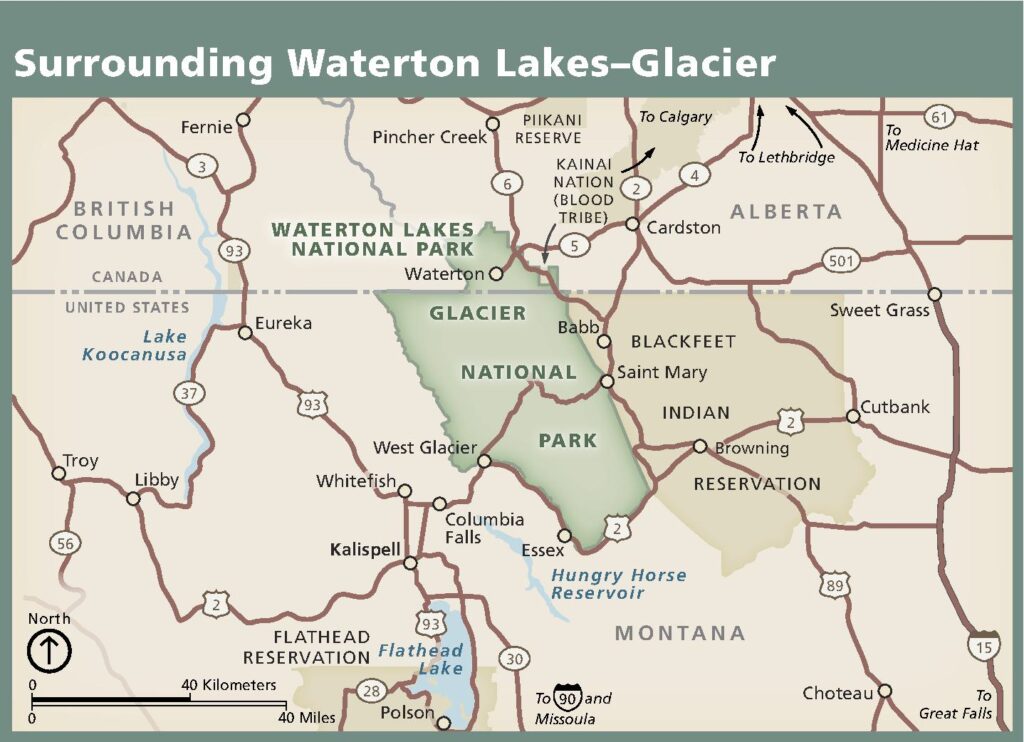
A brief summary of Native American history in and around Glacier National Park
For a little bit of context – Glacier National Park lies directly west of the Blackfeet Indian Reservation, and approximately an hour north of the Flathead Reservation, home to the Confederated Salish and Kootenai Tribes. Both reservations were originally established by treaty in 1855. The original territory of the Blackfeet Reservation originally included the East half of what is now Glacier National Park – this land was ceded in 1895 under a new treaty with the federal government.
The 1895 treaty was pushed for by figures like George Bird Grinnell, a conservationist with the goal of turning Glacier into a national park, and the Great Northern Railway, a company that aimed to transform the park into a major tourist destination accessible via their railway, which ran along the southern border of what would become Glacier National Park. The GNR and Grinnell presented the idea of purchasing land from the Blackfeet to the federal government, and negotiations began between the United States and the Blackfeet.
In the years leading up to 1895, the government’s systematic eradication of bison populations and failure of the government to provide the rations and food supply promised to the Blackfeet had caused a series of “starvation winters” from 1893 to 1895. The situation on the reservation was dire and desperate when the Blackfeet were approached with an offer to purchase the land. The Blackfeet requested $3 million for 800,000 acres of land – in the end, they sold it for only $1.5 million acres of land and a stipulation that they would still have access to it as they had before, including hunting rights.
Conflict over hunting and access rights of the Blackfeet in the bounds of Glacier National Park have been present since the creation of the park, which removed those treaty rights from the Blackfeet.
To read a more in depth ethnography of the relationship of the Blackfeet with Glacier National Park, check out David R. Craig, Laurie Yung, and William T. Borrie’s paper titled “‘Blackfeet Belong to the Mountains’: Hope, Loss, and Blackfeet Claims to Glacier National Park, Montana.” For a more detailed history of the Blackfeet in Glacier National Park, check out Mark David Spence’s “Crown of the Continent, Backbone of the World: The American Wilderness Ideal and Blackfeet Exclusion from Glacier National Park.”
The point of mentioning this history is to give a baseline for understanding what has and hasn’t changed in Glacier in the century or so since it was founded. Early involvement of the Blackfeet people in Glacier’s history generally reflects poorly upon the park, which certainly offers some explanation as to why it is seldom mentioned in modern park programming.
Living and Working on the Blackfeet Indian Reservation as a seasonal worker
To access the three east entrances to Glacier, you drive through the Blackfeet Indian Reservation. This means that a significant number of concessions there for the park are on the reservation, and because it is a highly seasonal economy, most of those companies hire mostly non-Native workers to staff their locations. While many small businesses are Native-owned, the major lodges and centers that include hotels, restaurants, stores, gift shops, etc. are owned by large corporations that own properties all over the park and in other national parks.
As far as I am aware, there are no members of the Blackfeet Nation on the staff of the location I worked at – St. Mary Village, right in the middle of the east side of the park, on the east entrance of Going-to-the-Sun Road, the only road through the park. In orientation (which many employees do not go through), there is brief mention of the fact that we live and work on the reservation, but it pretty much ends at a vague instruction to be respectful and make sure to purchase a recreation permit if we will be recreating on the reservation. Despite our customer service role, we received little to no training on how to deal with visitors asking questions about the reservation, regardless of the intentions of the questions, even though we were located on the reservation and followed the laws of the reservation. Something else to note – a significant portion of the employees at seasonal jobs are international students on summer work visas, mostly from Eastern Europe and Asia, who don’t always have the exposure to Native culture that people from the United States might have, and don’t always have a baseline level of sensitivity for what it means to live on Native land. It seems to me that it should be the responsibility of the company occupying that land to train their employees on how to do no harm while living on the reservation, but in my experience, it was something that was skipped over in our training.
My observation of visitors in regard to one aspect of living on the reservation definitely stood out to me when understanding how visitors interact with the reservation bordering the park. Like many reservations around the country, the Blackfeet Nation institutes dry days, where alcohol sales are prohibited on the reservation, during special occasions, holidays, festivals, elections, etc. The reaction from visitors ranged from very positive, people saying that they thought the practice was cool or positive and that they didn’t mind not being able to purchase alcohol because we were following the reservation laws, to people making vaguely racist remarks, saying the laws were ridiculous, or leaving reviews telling others not to stay on the East side of the park because of “arbitrary” limits on alcohol sales. The frequency at which people were surprised to learn they were on the reservation always surprised me – it certainly isn’t something that most people factor into their trip when they plan to visit Glacier. Every once in a while, we would get well-meaning questions and an interest in exploring more about the reservation and Native culture, but all too often, it felt like we were directing people away from the reservation to get alcohol rather than being able to help people acknowledge the significance of the land that we were on.
I don’t mean to say that everything was off about my experience working on the reservation – most people, particularly those who had returned to work there multiple years in a row, were in touch with the local culture enough to understand their place, and do what they can to respect and support locals. People have local friends, attend festivals and support Native-owned businesses when they can, and many do their best to educate their coworkers. Most days, Native-owned tour buses come through our restaurant, and we have a great relationship with their employees. Jack Gladstone is a major name on the reservation and in the park, and is a regular customer and friend of many seasonal employees.
My opinion, though, is that when you are already on stolen land when accessing the national park, and then are occupying space (physical, economic, emotional, etc. space) on the reservation, that there is an extra layer of responsibility to ensure that there is no harm being done by your presence, which is simply something I don’t see happening effectively right now.
What I Observed about Indigenous Representation in Glacier
In my own count, the non-Indigenous history of Glacier National Park, including that of the Great Northern Railway, the building of Going to the Sun Road, the lodges, etc. are mentioned approximately fifteen times across the park’s signs in entrances and on the main road through the park. “Nature” – broadly, including wildlife, is mentioned thirteen times, topics related to climate change are mentioned eleven times. Indigenous history and people are mentioned only four times – at least two of which are in reference to the same event – the dedication of Going-to-the-Sun road at Logan Pass, for which members of the Blackfeet, Kootenai, and Salish tribes were present. Only one sign, in the entire park, is completely focused on Indigenous history. This sign is located in the Two Medicine area of the park, and is the story of Running Eagle, a Blackfeet warrior, for whom a waterfall in the area is named (these signs are pictured below). The story is written in English on one sign and Blackfoot on a second, and is the only place in Glacier where Native people are the main focus of an educational sign. That’s absolutely wild! In addition, I was unable to find any mention of the 1895 treaty, only signs briefly declaring that the Blackfeet reservation had been established in 1855. Indeed, the only time that the treaty of 1895 was mentioned that I observed was by Jack Gladstone, an enrolled member of the Blackfeet tribe, musician, and co-founder of the Native America Speaks program in his own presentation. Jack boasts a long list of accomplishments, awards, and talents, and I am lucky to consider him a friend after getting to know him through my work this summer. His presentation broached the uncomfortable topics and history that until that moment, I had found totally unaddressed by NPS’ programming, through his music.
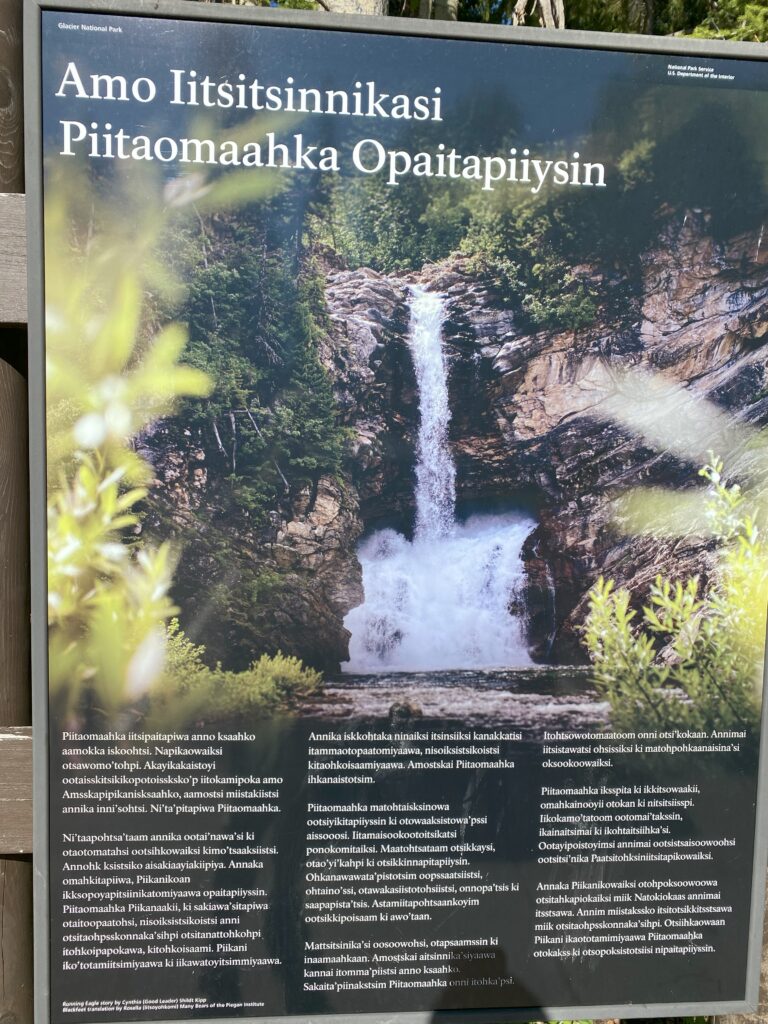
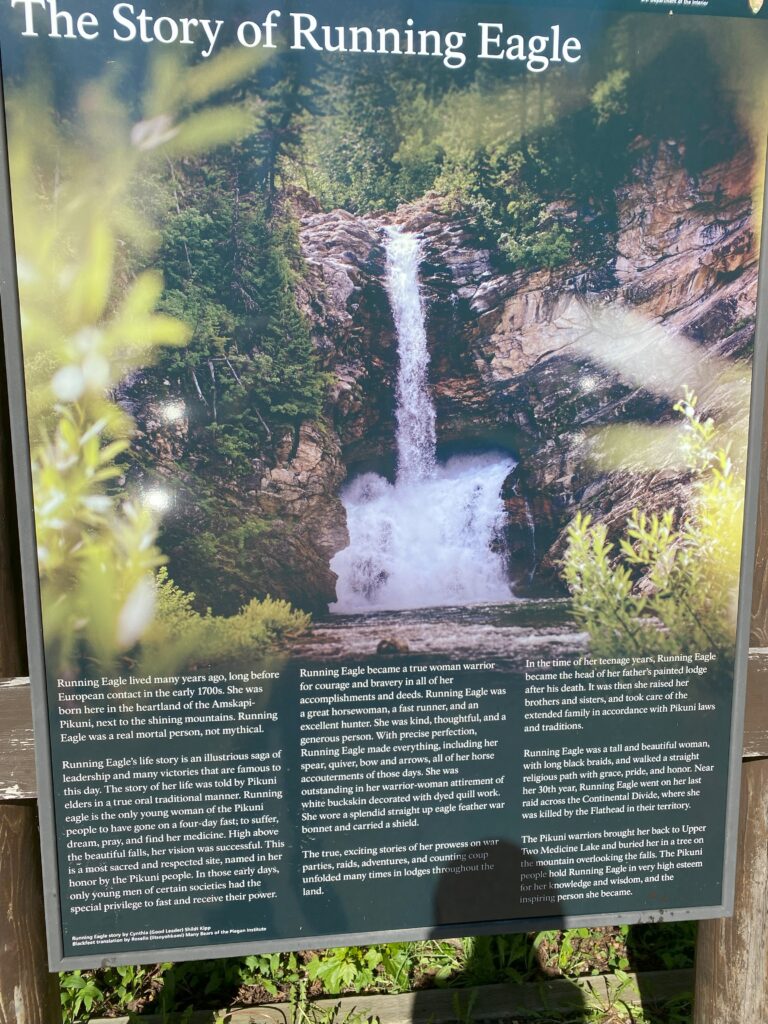
This isn’t to say that there isn’t representation, though. The Native America Speaks program runs every night in different locations throughout the park – the turnout is great, and the speakers are excellent. All of the programs I attended addressed the more difficult history (in a very family friendly way) that is brushed over by NPS. In addition, the Headwaters podcast, funded and run through the Glacier Conservancy, a nonprofit partner of the park responsible for fundraising and programming, features a multitude of Native American guests and experts who are doing important work in and around the park, as well as discusses the more complicated details of the park’s history with Indigenous communities. Indeed, the Headwaters podcast is what first piqued my interest in this topic. This is the part that is challenging for me to understand – it is obvious that important reconciliatory work is being done, but it is really hard to see it from the perspective of a visitor who isn’t going to go listen to a podcast, or attend a program.
Another explanation that occurred to me as for the lack of representation of Indigenous history in the park is the fact that most people don’t visit national parks as a cultural or historical project – they visit national parks for the natural beauty and sense of adventure that the parks bring. I would consider that a very reasonable explanation for this gap, except for that Glacier is an extremely built up and somewhat commercialized national park, and has been since its founding! Massive historical lodges sit at all of the main entrances to the park, and park programming, particularly physical signs and informational postings around the park are overwhelming centered on park history. While in the park, you have access to historical bus rides, historical boat rides, tours of historical lodges, all built by the Great Northern Railway or major concessionaires that followed the Great Northern Railway’s goal of making Glacier National Park a major tourist destination for Americans.
Resources to Support + Learn About Indigenous Communities in and Around Glacier National Park
If you are visiting Glacier and want to support the local community:
- Visit the Museum of the Plains Indian, located in Browning, Montana
- Visit locally owned restaurants on the East side of Glacier
- Attend Native America Speaks programs within the park – most are free, and all are valuable
- Utilize Native-owned tour companies rather than larger corporate ones, including Sun Tours, Rising Wolf Outfitters, Blackfeet Tours, and more!
- Attend North American Indian Days the second week of July in Browning, Montana. Be aware that photography is prohibited without purchase of a photo pass.
- Respect the park, leave no trace, and acknowledge the impact of your presence on Native land, on the reservation and within the park borders.
Things to do to learn more from home:
- Listen to the Headwaters podcast, particularly episodes like Confluence: Two Medicine, Becoming: Portraits of the West, Becoming: Landowners, Becoming: A Market Place, Becoming: A Destination, and Climate and Community with Mike Durglo, Jr., all available on Spotify and other podcast platforms
- Explore the Blackfeet Bison Project, and the documentary “Bring Them Home” which documents the project taken on by a small group of Blackfeet citizens with the goal to return wild bison to their ancestral homelands.
- Listen to Jack Gladstone’s music, which focuses on his experience in the world and on Blackfeet history.
Bibliography
Craig, David R., Laurie Yung, and William T. Borrie. 2012. “‘Blackfeet Belong to the Mountains’: Hope, Loss, and Blackfeet Claims to Glacier National Park, Montana.” Conservation & Society 10, no. 3: 232-242. https://doi.org/10.4103/0972-4923.101836
Spence, Mark David. 1996. “Crown of the Continent, Backbone of the World: The American Wilderness Ideal and Blackfeet Exclusion from Glacier National Park.” Environmental History 1, no. 3 (July): 29-49 https://doi.org/10.2307/3985155.
I would like to thank the Paul K. & Evalyn Cook Richter Memorial Fund for supporting this project.
